Council adopts budget focused on financial sustainability
Published on 24 June 2026
Somerset Councillors Brett Freese, Sally Jess, Mayor Jason Wendt, Deputy Mayor Helen Brieschke, Tiara Hurley, Michael Bishop and Stephanie Laycock delivered Council’s 2026-2027 Budget on Wednesday, 24 June.
SOMERSET Regional Council has today adopted its 2026-2027 Budget, delivering a responsible financial plan that maintains essential services while responding to significant cost pressures across fuel, materials and labour.
Mayor Jason Wendt said this year’s Budget had been one of the most difficult to prepare, with Council costs increasing by more than 25% over recent years.
“This Budget makes necessary decisions and is focused on long-term financial stewardship so Council can continue maintaining the essential services our community relies on every day,” Cr Wendt said.
The 2026-2027 Budget includes a 6% increase to general rates, a $42.90 per year increase to waste charges, an $11.20 per year increase in separate charges, and a change to the early payment discount to 5%.
Nearly 80% of Somerset ratepayers are residential, with the majority of those properties expected to pay between $2.73 and $3.09 extra per week.
Mayor Wendt said Council had worked hard to minimise the impact on ratepayers as much as possible while continuing to deliver core local government functions.
“Somerset remains one of the most competitively rated councils in South East Queensland,” Mayor Wendt said.
“We continue to maintain no overdraft facility, despite using some savings this year to support the Budget. Our long-term strong financial management will allow us to weather the uncertain and volatile global economic climate without being exposed to significant interest rate changes.”
Council is forecasting an operating deficit of $4.1 million in the 2026-27 financial year. This is due largely to a timing difference in the payment of the Federal Financial Assistance Grant, with 80% or $3.9 million of the next financial year’s grant to be paid before the 1st of July.
This is a timing difference which must be reflected in the budget, but it does not impact the financial sustainability of Council.
Contributing to the deficit is a $3.5 million investment in Council’s long-term operational health.
A new corporate management system will be purchased partly from cash reserves. This system is essential to running a more efficient, accountable and secure council which supports improved financial oversight and protects sensitive information Council holds on behalf of the community.
Mayor Wendt said the investment had been delayed for as long as possible, sparing ratepayers earlier increases.
“Unfortunately, this investment cannot be delayed any further without placing Council at risk as our current system will soon be obsolete,” Mayor Wendt said.
“Our budget forecasts project a return to a balanced budget beyond 2026-27.”
The $100 million Budget will continue to support key essential services including road maintenance, slashing and mowing, park maintenance, pest and waste management, and other community services that help keep Somerset thriving.
Council will also deliver major capital projects critical to Somerset’s growth, including the Kilcoy Indoor Sports Centre, Toogoolawah Library and Cultural Centre, and the Fernvale South Productivity Link.
Mayor Wendt acknowledged that the decisions made in this year’s Budget come at a time when households and councils alike are facing rising costs.
“We know these decisions aren’t easy in a time when everything is going up,” Mayor Wendt said.
“Thank you to the community for entrusting us to make the right long-term decisions for Somerset.”
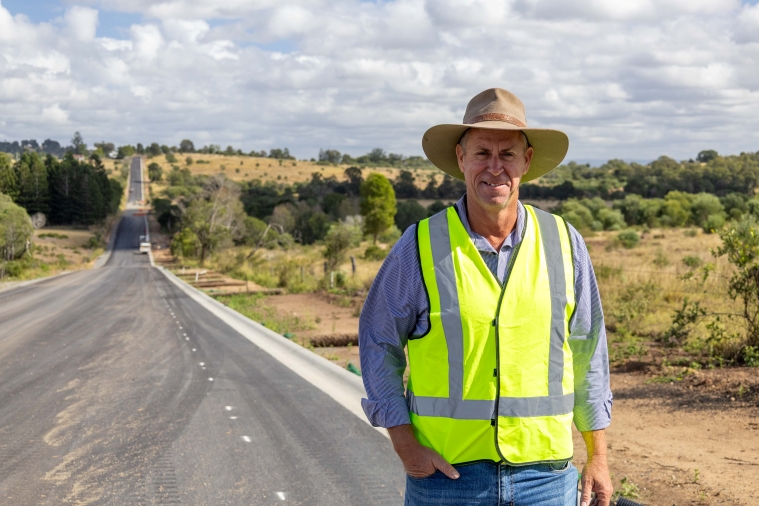
Somerset Mayor Jason Wendt.